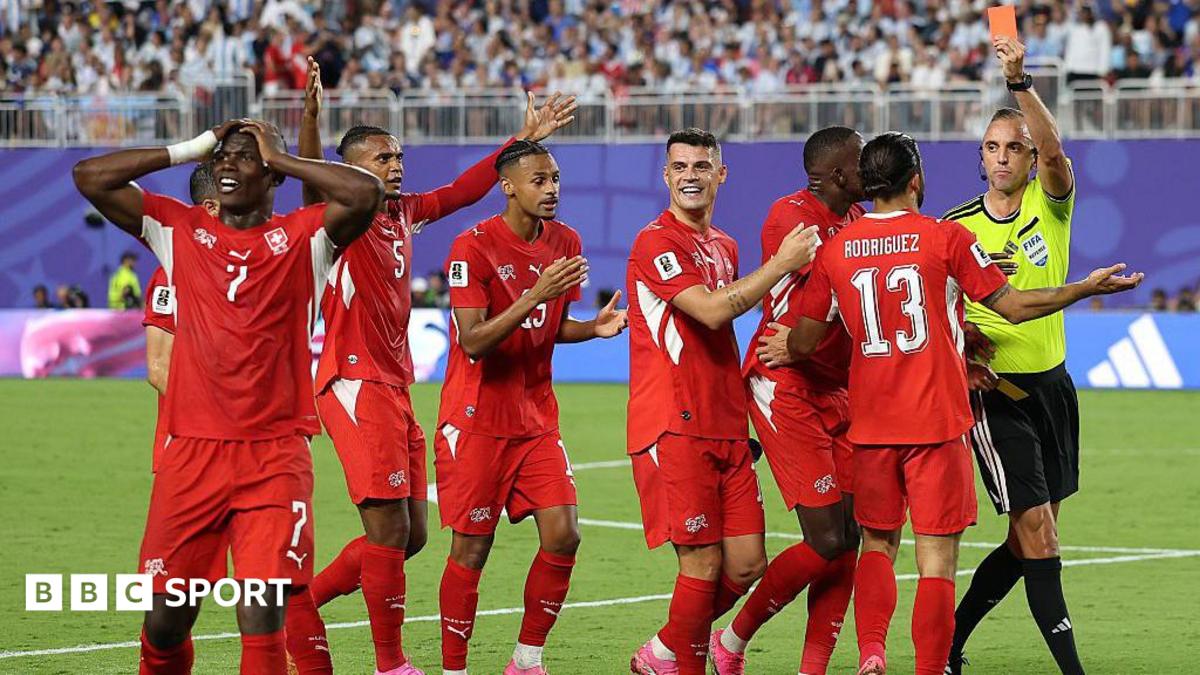
The VAR decisions against Almiron and Embolo proved popular with many fans, who felt it showed a willingness to try to end diving.
However BBC Sport spoke to a number of local teams who said the use of the wrong identity in the simulation had never been discussed before, and it was a complete surprise.
There has been considerable concern about the potential impact at the club level.
One league in particular has talked about how it can create “chaos”, where all yellow cards are reviewed to match.
There was another concern, about the additional pressure it would put on officials for their initial decisions.
It will create a two-tiered system, where the simulation can only be reviewed if a yellow card has been shown.
If a team had conceded a goal from a free-kick, where an opponent had made contact but there was a booking, there would undoubtedly be a debate about the role of VAR.
It can also be difficult to be consistent in what is considered a clear imitation.
As officials gathered for the opening matches of the European qualifying rounds this week, Uefa told its VAR that it should only apply the new rule in genuine cases of ownership of the error.
In a report before the World Cup, Pierluigi Collina – Fifa’s head of referees – made an example of the Euro 2016 final.
Referee Mark Clattenburg awarded Portugal a free-kick on the edge of the area, with France defender Laurent Koscielny booked for handball, although Portugal striker Eder used his arm.
In this case, FIFA said that VAR can intervene and give France a free-kick.
At no point in discussions or press conferences in the past few months has it been referred to – even if it would be the most obvious intended use if it was.
Uefa believes that self-identification is a genuine decision that does not require the referee to go to the referee.
It should only involve the same offense – handball as in the Euro 2016 example.
The change from foul to simulation is to review different cases, which are independent and, as in the cases of Almiron and Embolo, the referee has to visit the screen.
Therefore, Uefa believes that imitation is not a patent error.
Since VAR can no longer intervene in wrongful second yellow cards, it is possible to punish if the offending player is sent off for a double booking.
Acting can be penalized if it leads to a straight red card or penalty.
Uefa will look at the wrong corners but, unlike the World Cup, this will not include a possible offside when it is built and will only apply to the last touch.
The governing body for football in Europe has already rejected the option to intervene in issuing red cards if a player closes his mouth during a collision, Almiron and Piero Hincapie from Ecuador were sent off for doing so in the World Cup.
The chief referees of the 54 member countries of Uefa are expected to hold a conference next week where everything that affects the use of VAR will be discussed.
Self-awareness will be among the headlines, and BBC Sport understands that domestic leagues are likely to follow Uefa and use it as an authentic review.
Ifab was not willing to discuss the interpretation of the law when contacted.