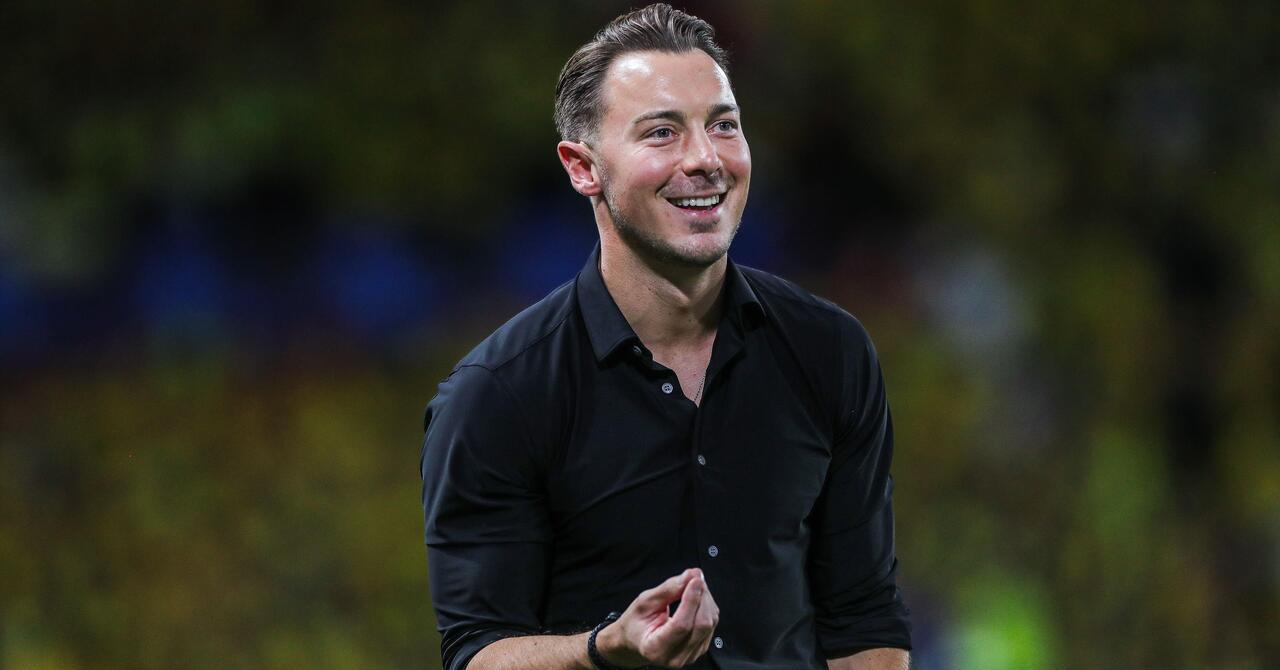
Matthias Jaissle is the hot favorite to become Newcastle’s new manager following the early departure of Eddie Howe.
Jaissle is unknown in the United Kingdom but has made a name for himself in Asia, helping Saudi Arabian club Al-Ahli to back-to-back Champions League titles.
Jaissle profile
Born: April 5, 1988 in Nürtingen, Germany
Playing Career: Hoffenheim (2007-2014)
Appearance: 60
Managerial Career: FC Liefering (2021), RB Salzburg (2021-2023), Al-Ahli (2023- )
Jaissle’s career begins because of Rangnick
Jaissle’s playing career was interrupted when he suffered a severe ACL injury playing for Hoffenheim against Hannover in 2009. He was not the same when he came back and finally hung up his boots in 2014.
Ralf Rangnick had brought him to Hoffenheim but then moved on to RB Leipzig and gave Jaissle the chance to start his coaching career in the youth department of the German club.
He worked his way up through the ranks – leaving briefly to become Alexander Zorniger’s assistant at Danish club Brondby – before being appointed Under-18s head coach at Salzburg, which, like Leipzig, is part of the Red Bull club network.
Promotions followed, first when he was appointed manager of Salzburg’s feeder club FC Liefering and soon after the top job, succeeding Jesse Marsch.
At the age of 33, he had a big career in Austrian football and ran with it, building a reputation for strong, high-quality football like Salzburg, who had an incredibly talented squad including the likes of Benjamin Sesko, Karim Adeyemi, Noah Okafor and Brenden Aaronson, who lifted the league and cup twice in his first season in charge.
The Saudi opportunity comes from Jaissle
He repeated this in the 2022/23 season before being sacked after it emerged he was talking about a move to Al-Ahli.
“Of course, you’re not the first person to see it as a dramatic move,” he told The Athletic in January.
“But at that time it was happening automatically. I wish the time was different, but sometimes it happens in football. There is interest, or promise, and then you have to decide quickly.
“But for me, the thought at that time was obvious – and let’s be completely honest – that financially it was something I had to consider. But the other part was the opportunity to coach a team that had just been promoted to the first league, with many fans and big stars – some stars, really – and it was a big step for me.”
Howe repeatedly declined to discuss Saudi’s human rights record – saying he did not have time to properly research it – but Jaissle admitted he had considered it.
“Yes, I was reading the headlines but at the same time I realized that the country is taking good steps to open the door,” he said. “There is a good feeling that things are better than before and will continue to get better in the future, not only in the club but in the city and the whole country, especially for young people.
“It is clear that change does not happen overnight, it will take time, it grows quickly and that gives you hope for the future, I have seen for myself that in many ways they are on the right track.
“And I wanted a challenge, I wanted to train abroad, in different cultures, and to work in English, which is not my native language.
“So, I saw it as an opportunity to improve as a coach. I’m still young, but I felt I had enough experience to manage the expectations of the players, and to lead the team the way I did in Salzburg and the way I played was seen.”
He took over an Al-Ahli squad that was full of players who had made their mark in Europe’s big leagues – Roberto Firmino, Riyad Mahrez, Franck Kessie and goalkeeper Edouard Mendy and Ivan Toney joined soon after.
Al-Ahli recorded a third, fifth and third Pro League in his three seasons in charge but his real success came on the continent by winning the Champions League trophy in 2025 and 2026.
What is his Jaissle’s play style?
Jaissle is a student of Rangnick and Red Bull’s highly engineered system.
He said: “I want to put pressure on the opponent as quickly as possible. And if we win the ball, I want to go as fast as possible towards the opponent’s goal. I am very vertical in that way.”
In Salzburg, he showed flexibility by taking different programs at home in games where his own will be successful and in Europe where they will have to stay.
“In Austria, we often faced teams that played a low block, but adaptation was always important,” he explained. “In the league, we were able to play in our own way, using the identity we have at the academy, going up through Liefering, and in the first team.
“But sometimes in the Champions League, I was trying to do the same thing. You can’t do that all the time. You have to be smart. There are times in the game when you have to play deep, which was not natural for us, and when you have to change the depth of your back or change the space between the defenders.
“That helped me prepare to come to Saudi Arabia. I had a team that was completely different in profile, and I had to think more game by game about formation, how and when to press, and that forced me to be more flexible – to improve as a coach.”