World Cup 2026: What’s wrong with penalties – is it time to end the ‘language’?

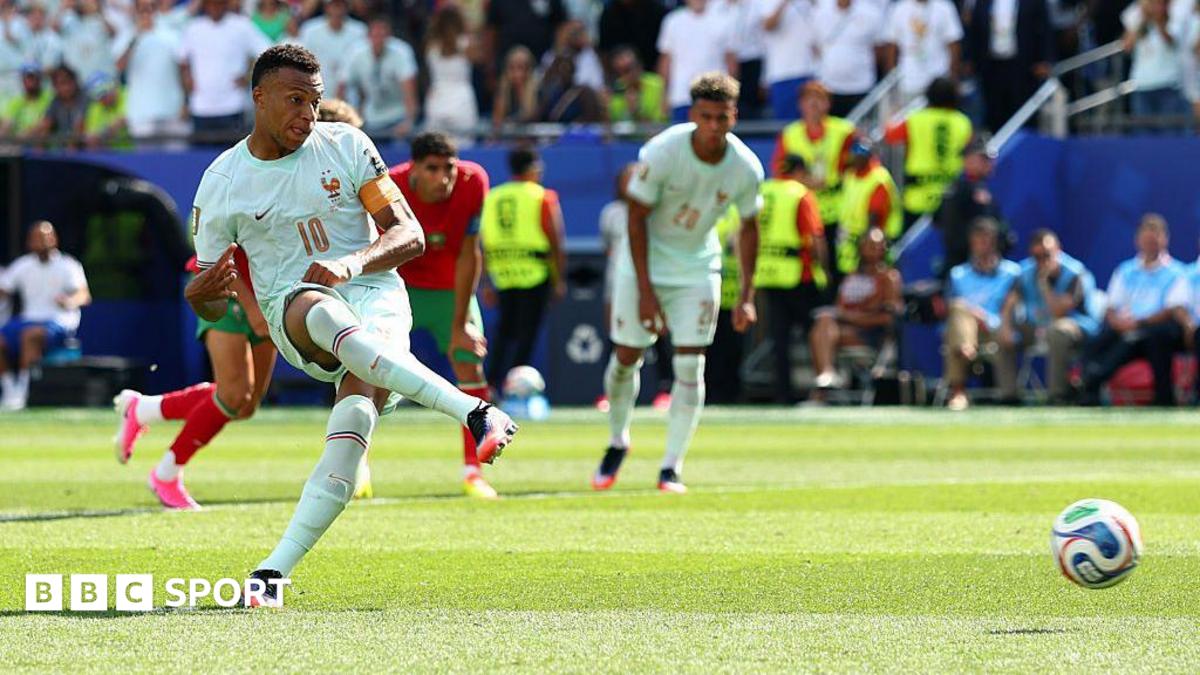
Whether or not France’s World Cup campaign ends with a third world title, few will remember Kylian Mbappe’s penalty miss in their quarter-final victory over Morocco.
The game in Foxborough was scoreless when Mbappe was fouled by Noussair Mazraoui. The France captain stuttered as he ran, looked at goalkeeper Yassine Bounou, and saw his penalty easily blocked.
Mbappe made amends on the hour when his stunning curling effort broke through the Moroccan defence, before Ousmane Dembele doubled France’s lead six minutes later to make it 2-0.
But his previous mistake, uncharacteristic of a joint goalscorer in the competition, begs the question: Is it time for players to stop ‘stuttering’ penalties?
On the list of things native football fans hate about the modern game, high run-ups next to players wearing gloves with short-sleeved shirts, diving, and the video assistant referee (VAR).
There is no strict definition of stuttering, but under Fifa rules, a player is allowed to stop or faint during matches as long as he does not do so directly before kicking the ball.
It’s nothing new – John Aldridge, Mexican legend Hugo Sanchez and Pele have all used the stutter to get a chance – but it can have a dramatic effect if a goalkeeper doesn’t commit to diving early.
Mbappe joins Bruno Guimaraes, Jorgen Strand Larsen, Lionel Messi and Harry Kane (although he managed to recover his penalty against Croatia, which he scored without stuttering his way) in penalty misses after stuttering in preparation.
Of the 26 penalty ‘mills’ taken during this World Cup – including penalties – 11 have not been scored, resulting in a conversion rate of 57%.
“This penalty I’m stuttering looks like it. The goalkeepers seem to have a march on it now,” said Ian Wright on ITV.
Marko Arnautovic, Raul Jimenez, Neymar, Mbappe, Cristiano Ronaldo, Yoane Wissa and Kai Havertz have used this method successfully.
Meanwhile, 24 out of 35 ‘non-farmer’ penalties were received, a conversion rate of 68%.
Overall, this has been a poor World Cup for players looking to convert from 12 yards.
A total of 30% of penalty kicks this summer, the second most of any World Cup since records began in 1966.
If shooting penalties are added to the equation, the miss rate rises to 35%, the highest of any World Cup since 1966.
“There’s an arms race going on. It’s definitely more difficult to score a penalty now. The reason is, the goalkeepers are bigger now, they run more,” former Scotland midfielder Pat Nevin told BBC Radio 5 Live.
“If you have your goalkeeper moving in the right direction, you have to hit the side net with speed, even if it can be saved.
“A very good penalty is no longer a guarantee, so you have to rethink it. I need to make sure that he goes the wrong way, that’s why the tongues try to send him the wrong way.
“Definitely the goalkeepers have data, they know what everyone is doing, there is no hiding what they choose because it comes out. There is always a battle to see how you get the advantage.
“Mbappe knows what his advantage is: preparation. He has a set [placing the ball before taking the penalty]he went through it twice today but the problem is that he has to go through it three times, the third time [he missed].”