How Jayden Adams’ death shook the community: ‘Being on the field was his happy place’ | Soccer

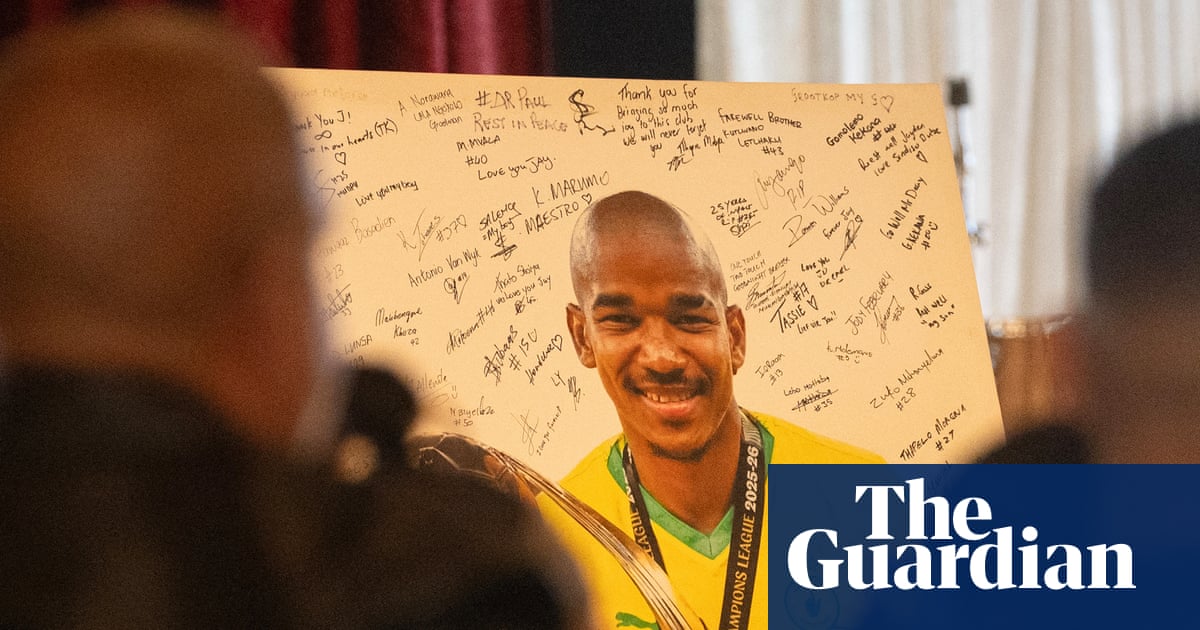
For Jayden Adams, the South African player who died this month aged 25, football was a “safe place”. Those words used by Adams’ junior coach, Steve Barker, at the memorial service last Thursday, tell you everything you need to know about his life beyond the field.
Adams’ warts were given to him almost from birth. Although he was born in a democratic South Africa, by the early 2000s the revolution was on the way to being betrayed. The vote was extended to all, but few could make full use of the freedom they had because the social and economic conditions in the country had not changed. Stellenbosch, where the Adams family was based, is a perfect example.
Its facade is a tourist’s dream: a university town surrounded by vineyards, Cape Dutch architecture and indie shops. Most visitors never go beyond the city center or the suburbs, which are home to the poorest and most neglected areas. Those places are the hangovers of apartheid, where the wealth was reserved for the elite and the marginal, working class communities of color, all invisible.
Ironically, that’s how Adams is often described. He moved in the shadows, both in society and in the sport in which he excelled. “Jayden was a man of very few words. He was quiet, shy and the youngest of his teammates,” said Brendine Johnson, a spokeswoman for the Adams family. “In the beginning, a lot of people missed his level of football because of his size, but he had a good fighting spirit.
Adams, whose funeral was on Saturday in Cape Town, loved the sport and his aunt Monica Thaoge recalled that, as a child, he would kick anything – “even an onion” she said in her memoir. His parents, Juanito and Candice, once mentioned potatoes as their son’s football of choice. No one in the family talks about lack of money because theirs was a community that strives to make life better. But there was an absence, especially in the beginning.
“Everybody in places like that is trying to make a living,” said Roger Telemachus, a former South African cricketer who grew up on the same street as Adams’ father in Cloetesville. For children, they may not have noticed so much because they were busy, especially in sports. Some fathers, like Juanito, really encouraged their children and everyone used to play everything in the street: tennis, soccer, rugby, cricket.
The problems were there for all to see and, according to Telemachus, they have gotten worse “in the last 20 years”. It includes crime, drug abuse and crimes ranging from petty to serious. Adams was able to escape that life when he moved to a more affluent area in Ida Valley, but still he did not have a life of luxury. For a time, this family of six, including four children, lived in a two-bedroom apartment. Sometimes, they were with his maternal grandmother, Marianna. “He grew up in his own backyard,” said Johnson.
Things started to change for Adams when he was selected for the Stellenbosch Academy Under 18 team at the age of 15. “The place was tough, especially if you weren’t big or tall enough, but when physical fitness wasn’t the priority, people realized that Jayden was technically very good,” Johnson said.
His coaches agree. Barker, who is the nephew of South Africa’s Afcon-winning coach, Clive, who is the coach of Simba in Tanzania, tested his feelings on the skills of Adams who recently died. “You get a lot of good footballers but you get a few top footballers. Jayden was good,” he told Newsroom Afrika.
“Jayden had three qualities that set him apart: an amazing first touch, his passing weight – I’ve never seen anything like it – and he loved the game so much. Being on the pitch was his happy place. He didn’t pass the ball, he stroked the ball. He was special and his football skills were outstanding.”
It was under Barker that Adams blossomed. He was the first player from Stellenbosch Academy to play in South Africa’s top division, the Premier Soccer League. After five years and calls from other countries, the richest team in the country, Mamelodi Sundowns, came calling. This year, at the beginning of his second season with them, Adams shaved his head, this time he made a joke to show his maturity and called himself “grootman” (big man). The nickname stuck.
Adams never said, but he may have noticed how much he had grown. By then, he had been selected, played and dropped from the national team after arriving late to training camp and angering the head coach, Hugo Broos. He also lost two of his schoolmates, including his best friend.
In February 2023, 19-year-old Oshwin Andries died of his injuries in Paarl, 16 kilometers north of Stellenbosch. Three years later, Jeandre Gaffoor, 20, drowned in the Krom River.
When Sundowns won the CAF Champions League in May, Adams presented his trophy to Andries. Such a loss weighed heavily on the town, but the Adamses had reason to celebrate.
after the promotion of the newsletter
His role in defeating Sundowns in the Africa Cup of Nations and being called up to the World Cup squad showed that Adams is about to grow in the way he played. After the first season at Sundowns, where he always played from the bench, his place in the team was in doubt, he has become a mountain in the team. In Adams’ memory, Sundowns head coach, Steve Komphela, called him “the heart of our team and the heartbeat of our way of playing” who “understood the game as a coach and played it as a player”.
Last year, Adams played to people who may have known him well from years ago and surprised others with his courage and determination to succeed. The captain of South Africa, Ronwen Williams, recalled the incident of this year’s Africa Cup of Nations when the young Adams faced Mali with the sweet names of the area. Williams asked Adams if he knew the size of the player he was riding, but Adams backed off and replied that the Malian player would not understand that.
“That’s the character he had,” Williams said at the memorial, smiling through tears as he said goodbye to his colleague whom he called “my ma se kind” (mother’s child, a term of endearment used in South Africa).
As his star rose, Adams was careful not to advertise his success. Jayden knew what he had, but he didn’t want to express it. “You find people who are really good on social media. Jayden wasn’t like that. And he wanted to give back. After every game, he would give shirts and boots to kids who begged.”
He also focused on feeding his family because he “always promised them that he would change their financial situation”.
In the World Cup, Adams played for them, even in severe pain. His grandmother Marianna died the day before the match between South Africa and Czechia and Adams chose to continue with the team. He played that game and seemed in good spirits afterwards to call it a 1-1 draw, even if he felt differently.
He also played the next match against South Korea, which the country won for the first time. Post-match pictures showed him sitting while the entire squad celebrated with a signature song and dance.
At the memorial, Komphela gave the Adams family a Bible verse as consolation, but it may be brief. Psalm 23:4: “Though I walk through the valley of the shadow of death, I fear no evil, for you are with me.”
They will know that Adams took that journey many times during his short life and was never afraid. He leaves behind his parents, three siblings, his partner, two children and a community that has gone through what should not be a neighbor. In all that, he doesn’t want it to be known that he has been in the news for a week in the world of football. A minute’s silence has been observed at several World Cup matches in Adams’ memory. That’s not how his family would have pictured him coming into the world, but it showed them that, in football, he was always more important than anyone thought.
“I don’t think the public knew how much he was and how much people enjoyed his football,” said Johnson. “It’s very scary.”