Four passes in 19 minutes: poor numbers after England collapse | 2026 World Cup

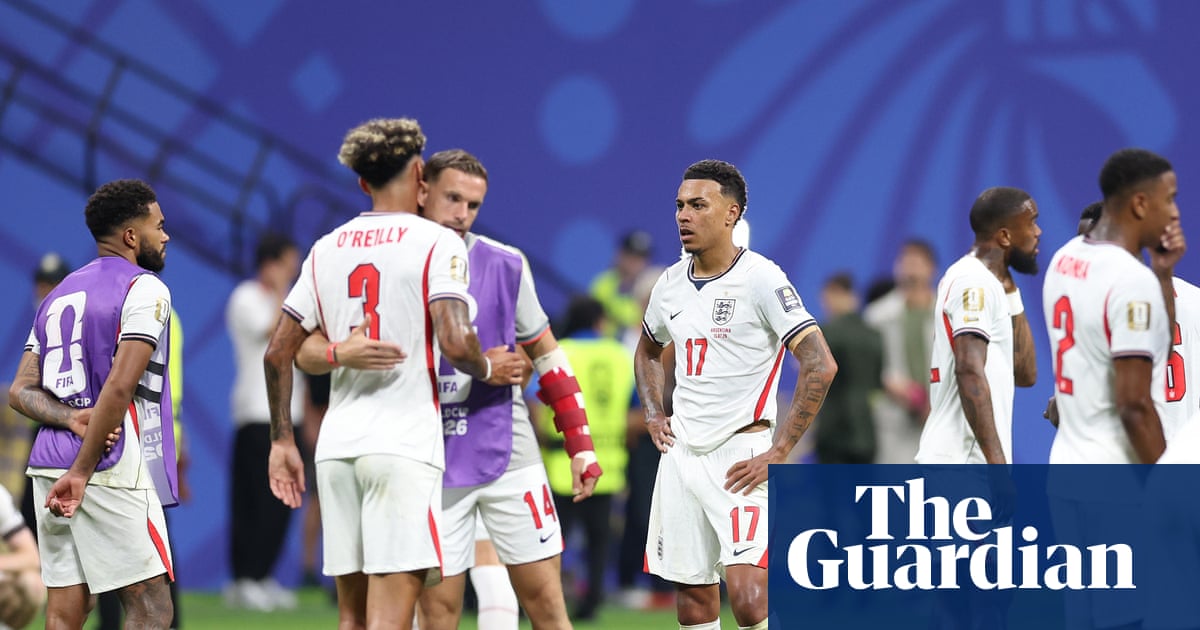
There will be future training courses using footage of England playing Argentina to show how not to defend one goal. If that sounds harsh, the data from the match proves that scenario.
Many grim figures emerged when the autopsy began. First up is OptaJoe, who noted that England held 12% possession in the 30 minutes between Anthony Gordon’s goal and Argentina’s equaliser. “That is the least for a team to win at least 10 minutes in a World Cup match in the last 60 years,” they added.
It gets worse when we cut this time. Compared to what’s to come, Thomas Tuchel’s team did very well before the hydration break. Harry Kane’s brilliant pass set up a shot in the 66th minute, before the captain scored a quick try as England pulled a goal back in the final third. Although Emiliano Martínez’s goal was not seriously threatened, the sequence suggested that Argentina could stay in their place.
That threat disappeared when Ezri Konsa replaced Gordon as England adopted a 5-4-1 formation. The change left them with no real pace at the break. As big a call as replacing Kane would have been, he offered little advantage if the team tried to see the game through with a low block.
Here’s what Tuchel has to think about as he looks forward to the third place play-off rather than the final this weekend. England’s goal difference across the competition was +6 in 6.3 games, or +0.82 per 90 minutes played. It’s interesting how variable it was for different players on the field, as we should be aware of learning too much from small samples of individuals in team sports. The goal difference was +2.01 per 90 when Bukayo Saka played, +1.16 for Reece James and +1.14 for Gordon.
Pace helped them and could have been here, however the Arsenal winger stayed on the bench. Having a speedy player to point forward would provide a way to escape pressure.
About 19 minutes separated Konsa from scoring the winning goal. England attempted 11 passes in that period.
It’s eleven. This isn’t Spinal Tap, it’s a World Cup semi-final. Only four passes in this spell were completed: two from the restart after the sub as Jordan Pickford fed the ball to John Stones before quickly receiving it, another in stoppage time when Kane found Jude Bellingham only to give the ball away. Another successful pass? Bellingham’s offense after Enzo Fernandez’s equalizer.
That sequence summed up how England’s hopes were dashed. Bellingham cut back to Pickford, who sent a long ball to Kane to no avail. This goalkeeper is the one who scored five out of seven passes for England that were unsuccessful between Konsa’s introductions and made it go 2-1, his three attempts ended.
The lack of game management was another problem. Argentina tend to ruin the game with fouls (not all awarded) until they go back. England conceded one free kick between Gordon’s goal and the 97th minute and made their last successful game of the tournament for the 63rd time.
To top it all off, England conceded a header from 174cm tall Lautaro Martínez after subbing out 201cm Dan Burn to counter Argentina’s threat. Burn’s only touch came in the final third after England had gone behind. In their place of punishment he was useless, an incredibly large decoration.
Whatever numbers you use to analyze the time after England went ahead, the numbers don’t add up.