‘Diego, give us a hand’: Argentina v England revives historic tension | 2026 World Cup

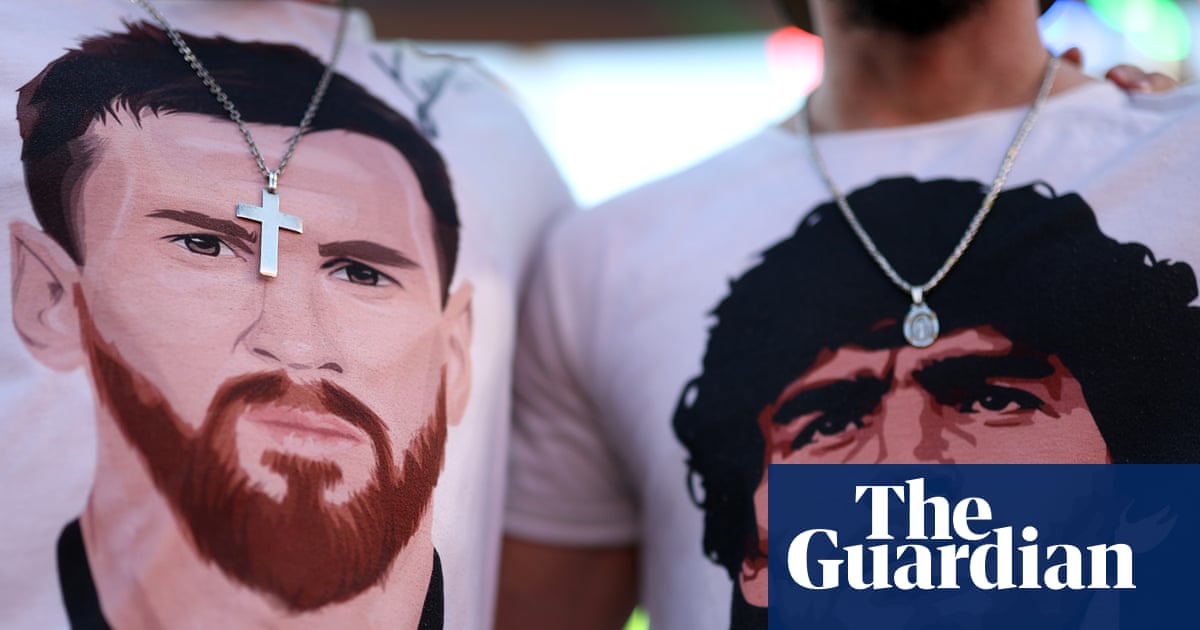
When Argentina’s national soccer team entered the dressing room after beating Switzerland 3-1, they celebrated by singing the country’s unofficial World Cup anthem.
“For the Malvinas, for Diego,” Lionel Messi and his teammates sang, invoking the Falkland Islands – known as Islas Malvinas in Argentina – and football legend Diego Maradona.
The word was already all over Argentina at the tournament, but it took on new significance when it was confirmed that Wednesday’s World Cup semi-final will pit Argentina against England again.
Nearly four decades after Maradona’s “Hand of God” goal and his famous solo strike helped Argentina to victory in one of football’s most politically charged games – the one that followed the 1982 Falklands War between the two countries – Wednesday’s semi-final is once again being discussed, in Argentina and the UK, more than the game itself.
“Behind the Argentinian team there are people who are still in pain, who don’t want to forget their history, who want to win on the football field,” said Pablo “Palmito” Quintana, the singer who wrote the song, explaining why he included the word “Malvinas” in the song. Quintana, 30, wasn’t there during the fight or during the 1986 quarter-finals, but he admits these games are “not just games”.
“The 1986 game was good for everyone who lived through the war,” said Aldo Leiva, a Falklands/Malvinas war veteran and Peronist congressman.
“Football has rules and a referee. This was not the case in the war. Many Argentines saw the victory – and the ‘hand of God’ – as a way of confirmation because they believed that Britain acted without rules, especially by sinking the General Belgrano,” he said, referring to the Argentine ship that capsized and was sunk by the British outside the agreed area. The attack resulted in the death of 323 workers.
Víctor Hugo Morales, the Uruguayan journalist whose live commentary of the 1986 game became part of Argentine folklore, said memories of that game were “recurring” again.
He said that, like Argentine players today, Maradona himself “insisted that it was just a game of football.” [ahead of the game]. But deep down, there was no doubt that the Malvinas war was in everyone’s hearts.”
“Argentina and England have become a thing of the past. Before 1986, it was another game. Since then, it has carried a political and emotional weight far beyond football,” said Morales, who described Maradona at the time as a “cosmic kite”.
Argentina’s media relies on the image. Crónica, a TV channel known for its sensational headlines, previewed the game with captions such as “Argentina vs. the English ‘pirates”, “Messi, with an M for Malvinas“ and “Diego, give us a hand”. The sports daily Olé focused on what he described as a good omen: “It’s official – Argentina will face England in blue, like in ’86.”
Several Argentinian outlets also reported that, before the semi-final, Godoy Cruz’s football club hung posters in its stadium that fans had taken from England fans during the 2014 World Cup, in what was widely interpreted as an act of provocation.
The dispute also comes after right-wing president Javier Milei repeatedly praised Margaret Thatcher, the British prime minister who was Argentina’s first public enemy during the 1982 conflict. “For many Argentines, England’s defeat will be seen as a political reprimand for Miley,” Morales said.
after the promotion of the newsletter
In Argentina, the islands remain a sore point. Even before the war, children were taught at an early age that Malvinaswere was an important part of the country.
“The issue of Malvinas is on the minds of the Argentine people,” said Morales. “The British probably did not consider these islands until after the war. [confronting Argentina] he’s struggled since ’86 because of what happened in that game – the handball goal and another brilliant Diego goal – but not according to Malvinas,” he said.
Daniel Filmus, a politician and former Argentinian press secretary related to the Falklands, said that the claim to the islands was included in Argentina’s national identity.
“The feelings that many Argentines have about the Malvinas can be heard in football songs. Both the song that was popular at the last World Cup and this year’s song include the islands,” he said.
“Argentina is one of the few countries that, almost 200 years after losing the land, still keeps that claim alive,” he said. “Argentinians take it with them wherever they go.”
Although the conflict may remain small in the collective national memory in the UK, Wednesday’s game has already ensured that the Falklands war is once again a top story in the British media. The Daily Telegraph reported the comments by Pablo Quirno, Argentina’s foreign minister, after he called the Falklands Islanders “illegal immigrants” in a story calling for talks on the territory.
There was also uproar over former England footballer Gary Lineker – top scorer at the 1986 World Cup – mentioning the name of Argentina’s islands, the Malvinas, as well as their English name on his podcast, insulting Mark Dolan, the presenter of Rupert Murdoch’s digital platform, Talk, who said “it’s time to show this red card”.
Meanwhile, Solezwe newspaper mentioned that the Argentine players were trying to focus on football. “We know what the game against England means to our country, but it is a football game and we will try to deal with it in the best possible way,” midfielder Leandro Paredes was quoted as saying.