NEWYou can now listen to Fox News articles!
President Donald Trump highlighted NASA’s ambitious plans to launch its first nuclear-powered spacecraft to Mars within the next two years, reaffirming his administration’s push to expand American space exploration and eventually send astronauts to the red planet.
Speaking at the UP Summit at Kennedy Space Center in Cape Canaveral, Florida, Trump touted the mission as part of his administration’s broader ambitions to expand America’s presence beyond Earth.
“Within the next two years, NASA will launch the first-ever nuclear-powered spacecraft to Mars,” Trump said.
The president described the mission as a step toward eventually sending American astronauts to the planet.
TRUMP CALLS ISS CREW FROM HOUSTON TO PRAISE SPACE PIONEERS AND OFFER ‘OVAL OFFICE TIME’
President Donald Trump highlighted NASA’s plans to launch a nuclear-powered spacecraft to Mars within two years during remarks at the UP Summit at Kennedy Space Center in Florida. (Eric Lee/Reuters)
“We’re going to be paving the way for astronauts to plant the Stars and Stripes on the red planet,” he said.
The planned mission comes as NASA’s Artemis program aims to establish a long-term human presence on the moon before eventually sending astronauts to Mars.
Earlier this year, astronauts completed a lunar flyby during the Artemis II mission. Artemis III is scheduled to test spacecraft and landing systems in Earth orbit in 2027, while Artemis IV is expected to attempt a lunar landing in early 2028, before the end of Trump’s presidential term.
PETER NAVARRO: TRUMP’S ARTEMIS VISION IS NOW FLYING — AND CHINA IS PAYING ATTENTION

NASA Administrator Jared Isaacman presents President Donald Trump with a plaque while astronauts greet him during NASA’s Max Power event at the Kennedy Space Center, in Merritt Island, Fla., on Nov. 6, 2026. (Joe Skipper/Reuters)
Trump also outlined his administration’s plans to accelerate space exploration and establish a lasting American presence beyond Earth, saying the U.S. “will establish a permanent presence on lunar soil.”
The president pointed to his recently issued American Declaration of Freedom in Space, which asserts the right of Americans to explore and settle beyond Earth under U.S. law.
“Just this week, I issued the American Declaration of Freedom in Space, proclaiming all of space opened for American settlement, American civilization and American freedom,” Trump said.
Before introducing the president, NASA Administrator Jared Isaacman also discussed the space agency’s Mars ambitions and long-term goals.
CHINA IS RACING TO THE MOON, AND AMERICA MUST CLEAR THE PATH FOR SPACE INNOVATION

A “selfie” taken by NASA’s Perseverance Mars rover, made up of 62 individual images, on July 23, in this image released Sept. 10, 2025. (NASA handout via Reuters)
“We are going to venture farther into the solar system and move closer to that next giant leap,” Isaacman said.
He described the administration’s ultimate goal as the day “American astronauts plant the Stars and Stripes on Mars.”
The administration has previously outlined broader space ambitions, including plans for a U.S. Space Academy, which Trump announced in August. The proposed institution would train students for careers in the Space Force, NASA and the civilian spaceflight industry.
Trump also emphasized his broader vision for American space exploration.
CLICK HERE TO DOWNLOAD THE FOX NEWS APP
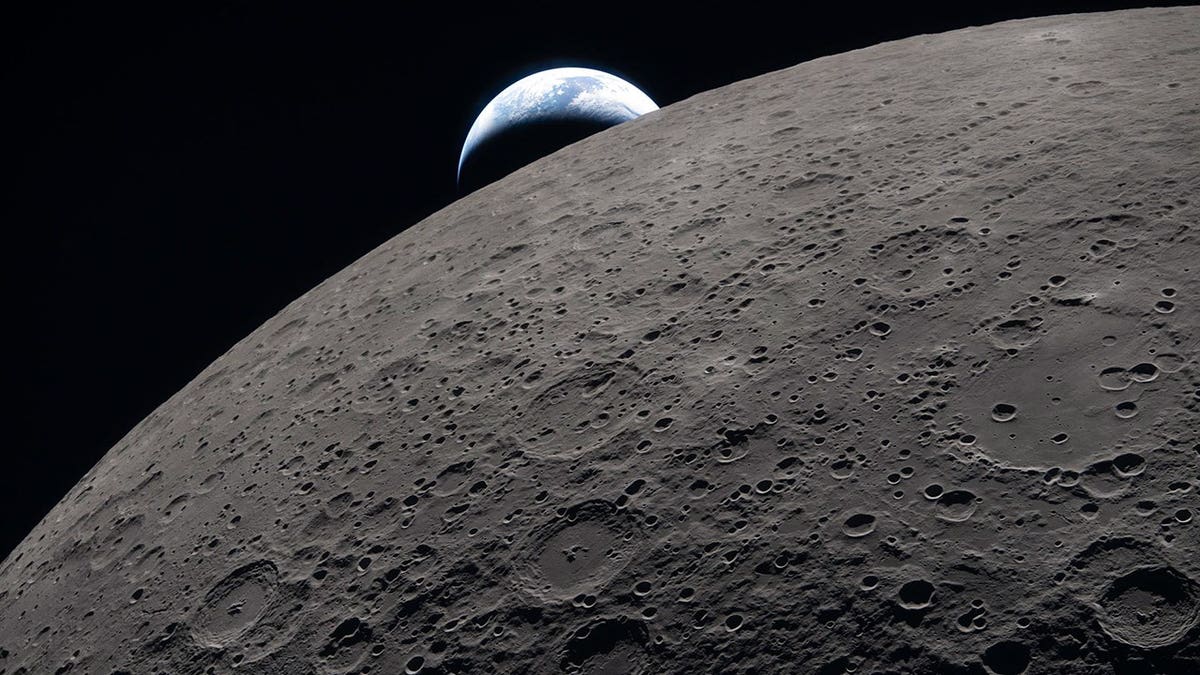
The lunar surface fills the frame in sharp detail, as seen during the Artemis II lunar flyby, while a distant Earth sets in the background. This image was captured at 6:41 p.m. EDT April 6, 2026, just three minutes before the Orion spacecraft and its crew went behind the Moon and lost contact with Earth for 40 minutes before emerging on the other side. (NASA)
“Our calling is to explore. Our purpose is to build, and our aim is always to win,” he said.