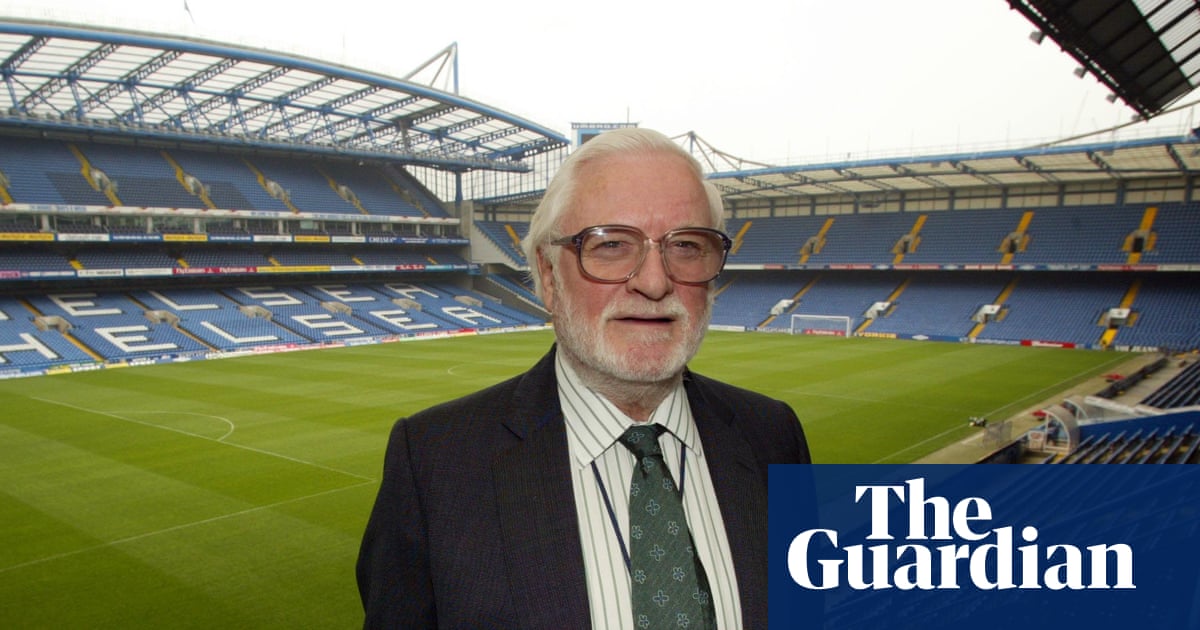
For more than 20 years, Ken Bates, who has died aged 94, was synonymous with Chelsea Football Club, which he bought in 1982 from the Mears family, who lost control after renovating the west side.
Bleeding money, heavily in debt and about to sink into what was then Division Three, the London club dropped him for £1. The two disputes, a financial frenzy decades later, were £97m in debt, but since its sale to Russian oil tycoon Roman Abramovich Bates has nevertheless pocketed £17m.
In 2004, on his way out, he made a gracious speech to the board during lunch. That night, his lawyers filed a letter saying they wanted a further £2m to cover lost expenses and a number of benefits associated with his former position. The group disputed the claim.
Conveying a deceptively intellectual air with his trademark scruffy beard and mustache, Bates came up with his infamous reputation: “I’ve always said what I heard, and some people never liked it.” At Chelsea, he gave the manager as other men changed shirts. Nine people came and went during his tenure as chairman, many were fired in controversial circumstances.
He once banned two of the side’s leading lights in the 1970s, Ron Harris and Peter Osgood, for publicly criticizing him, and used his match-day program notes to attack various personalities and settle scores. At one point, proposing to use it as a nursery club, he invested £100,000 in Partick Thistle, promptly forbidding its staff to wear anything on their feet except black shoes. Sir Alex Ferguson once compared him to Chairman Mao.
In 1985, without seeking permission from the council or the FA, he built a high fence around parts of the ground, installing electric cables to keep out hooligans. The idea had come to him on one of his morning walks around his dairy farm in Beaconsfield, where a similar system was used to keep the cows. Permission had not been sought from the council and the FA, and the experiment was short-lived.
While all this happened, he saved Stamford Bridge from being flattened by property developers, returned Chelsea to the top position of English football, developed the world with a hotel, accommodation, food arm, tourism business, megastore and radio and TV stations (ideas that have long been accepted by other clubs) and, as chairman of the League, he pushed for the equal distribution of the Premiership of the parachute TV and the TV payment system.
Born in Ealing, west London, and brought up on a council estate, Bates was 16 when he learned that the couple he knew as mum and dad were, in fact, his grandparents. His mother, Elizabeth (nee Philpot), died when he was 18 months old, leaving him in the care of his father, Thomas Bates, who promptly bailed him out. His sister, who was being cared for by another couple, was an adult when she met him. Still, he looked warmly at his adoptive parents.
Born with a club foot, Ken suffered four unsuccessful surgeries as a child before, in 1938, “daddy” raised £20 for the fifth time. This was successful. At his primary school, Cuckoo School in Hanwell, he played as a forward and dreamed of a career in professional football.
He proudly described himself as the type of player who was called a dog: “A hard worker, someone who never gave up on the ball. I didn’t like to let people pass or beat me.” Later, he had a successful trial for Chase of Chertsey, then famous as a feeder club to Arsenal – “Not bad for someone born crippled,” said Bates, “but at that level, with the bad foot I have, some kind of imperfection came through.”
Her grandfather was not an advocate of working women, so “mother” took a job as a private cleaner to earn enough money to put Bates through the Ealing district school. At 15, he was offered a job on the Brentford FC staff, but was discouraged from leaving school by his head teacher, who saw Bates as having the ability to get ahead in life.
When he was 18, he took a job in the booking office at Paddington station. He got bored after nine weeks, entered the City to train as an accountant and spent two years there, studying. Then he threw himself into work and making money; he had seen his grandparents struggling and vowed that he would never be like that. “I had to fight for everything I have, if you start with nothing you are driven by lack of self-confidence, nothing in life is easy.
At the age of 23, he bought his first Bentley and in his early 30s he was rich enough to retire, making his fortune in a mixed concrete business which he sold four years later for more than half a million dollars. He endured retirement unemployment for less than a year, building a second fortune with, among other interests, a Buckinghamshire dairy farm that, he said, made the best ice cream in England.
In the 1960s, he was chairman of Oldham Athletic and bought control of Wigan Athletic in 1981. A year later came the chance to catch Chelsea. The next 10 years were spent battling property developers Marler Estates, who owned a large part of the freehold Stamford Bridge. Emerging victorious in 1992, Bates founded Chelsea Village Ltd and introduced a transformation of the stadium and club, appointing Glenn Hoddle as manager, who took the team to the 1994 FA Cup final.
Things may have been going well on the pitch but the club has been struggling financially. In 1994, in an attempt to boost the fund, businessman Matthew Harding was appointed to the board after Bates called in new investors. Bates soon found himself at odds with his new teammate and potential replacement, eventually blocking him from the directors’ box. Harding’s death in a helicopter crash in 1996 did not end the controversy – Bates described him posthumously as a “bad guy”.
Often the object of harsh criticism in the media, Bates relished the attention. As a grammar schoolboy who sent both his sons to Eton and liked to flaunt his wealth, his farewell signal to sporting hacks after the game was, “I’ve gone to my 300-acre farm. You might as well go back to your council houses.”
His reputation as an ambitious dictator and a ruthless speculator was secretly belied by generosity and strict loyalty to select friends. But he said football has always been his love. In 1998, he said: “I’m still playing, really. I kick every ball, clear every space and score every goal. The players in their green shirts … how I wish I could be one of them.”
After leaving Chelsea in 2004, he moved to Monaco where, once again, he was “stupidly bored” with no intention of retiring. A year later, he bought a 50% stake in Leeds United, another club in financial turmoil that after Premier League glory had slipped into the bottom tier due to the debts amassed by Bates’ predecessors.
He was quick to say that Chelsea had poached his two Elland Road stars. The Chelsea directors, he said, were “a bunch of shysters from Siberia”. Chelsea’s response was to lodge a complaint with the FA against him and Leeds for alleged racism and bringing the game into disrepute. “I haven’t laughed so hard since Ma grabbed her breasts,” Bates replied.
After becoming sole owner of Leeds in 2011, Bates sold it to private equity group GFH Capital the following year, stepping down as club president. He was quickly stripped of the position, allegedly after a dispute over the payment of his private jet, and returned to retirement in Monaco. “It’s easy to sit behind you and complain that nothing is happening to you,” he once said. “Make it happen. Then fight for it. Fight for what’s yours.”
Bates is survived by his third wife, Suzannah (nee Dwyer), and three daughters and two sons from his first marriage.