‘Getting it out was great fun’: recalling England v Argentina dramas in 1998 and 2002 | 2026 World Cup

Aamid conflicts, wars, a deep history going back to the invasion of Britain in 1806 and 1807, the hand of God and the boot of Beckham, there is also an acknowledgment from those closest to the struggle that England and Argentina make perfect football partners.
Described as the only trans-continental derby, a rival engraved in politics and history and a legend of football, most of the Argentine footballers light up when it comes to England.
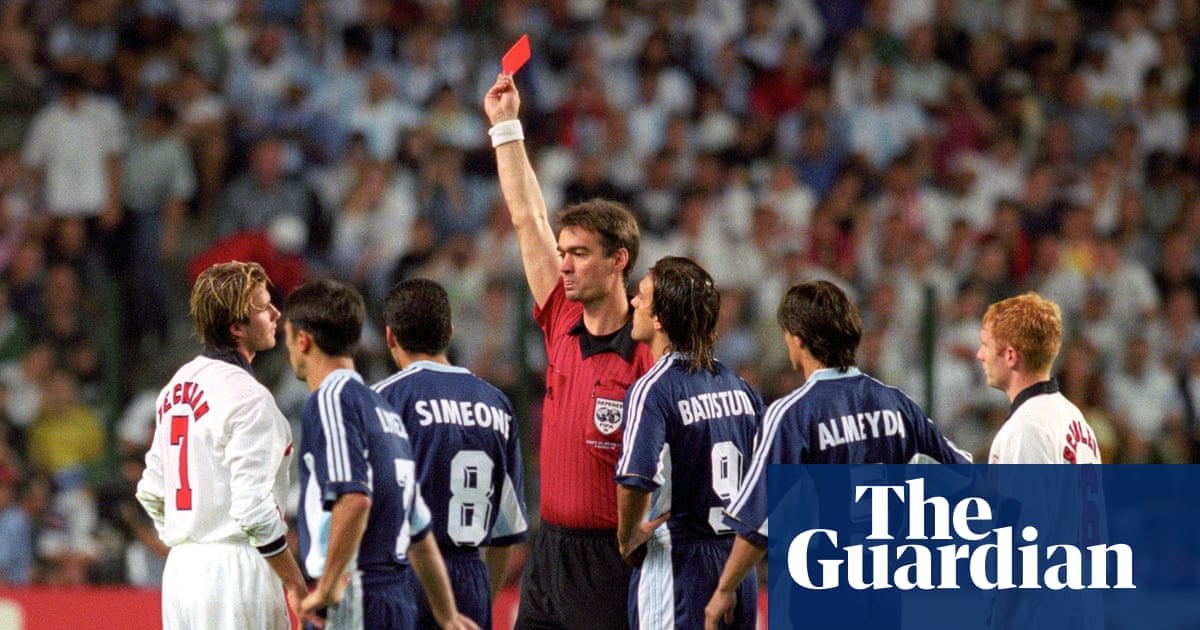
Take Diego Simeone, now Atlético Madrid’s embattled coach but once David Beckham’s arch nemesis, the man who fell to the ground when Beckham’s stupid tackle caught him at the 1998 World Cup, thus changing the course of that match with Beckham’s red card.
“I love playing against the English,” Simeone told me in 2002 when he and his then-wife, Carolina, invited me to their luxurious Rome home for an interview ahead of that year’s World Cup match between the two countries. “England football is always open, aggressive and passionate. Whether you win or lose when you face English teams, you always feel like it was a fair competition. The first time I played with them was at Wembley in 1991…” At this point, Simeone rolled up his trouser leg and pointed to the scar on his groin. “I still have a souvenir from Stuart Pearce from that day. What a great game.”
As for the famous game in the last 16 in 1998, it was the first game of the World Cup since Diego Maradona’s hand of God in 1986 and England were again defeated by the cunning of Argentina, especially that of Simeone. However, he remembered it mainly as one of the great World Cup tournaments.
“It’s the best international game I’ve ever played in,” said Simeone. “See [England] they were amazing that night. Alan Shearer and Paul Ince were extraordinary. At times it seemed as if Shearer was fighting us alone. You have to remember that they played 70 minutes with 10 men.”
Simeone delivered the above line as if he didn’t care that he was the protagonist of the event. If he didn’t really repent, he was a mite shy about the world of pain he caused Beckham with his 47th minute send-off. “Ten brave lions, one stupid boy” was the Mirror’s headline and Beckham’s picture was hung on a noose outside a London pub.
“That’s what goes over the top,” said Simeone when I relayed this story. “It’s not that it scares me, but it’s a wake-up call for everyone, including journalists, you have to be careful.
It wasn’t just my fault. There is also a lawyer involved. I think David had problems for a few months after that. The media put all the blame on him. I don’t think that was fair at all. You just made a mistake, it’s a natural reaction. “
It should be mentioned that Simeone and Beckham were photographed together in Miami during the match between Argentina and Cape Verde. “I got hit by an old friend,” Beckham wrote on Instagram.
Although Argentina will always have Maradona’s second goal from 1986, a goal that had more impact and is often regarded as the best, England should at least have Michael Owen’s stunning run from the middle to make it 2-1 in 1998.
Owen was only 18 at the time and in 2018 he met Glenn Hoddle, the England manager that day, on the 20th anniversary of the game. “There was no fear in him,” Hoddle said. “When Michael turned, ran and hit the first two players, I remember thinking: ‘Bloody hell! But [Argentine defender] Roberto Ayala was too deep, he was almost in the D of the penalty area and I didn’t see him. But when Ayala met him, it was clear that he didn’t know how fast Michael was going.”
Owen agreed. “Becks [Beckham] he played me the first ball and one of their midfielders was a few yards away from me. I just thought, if I touch it right, I can run past him and start attacking. It was after the first touch, I took it where I took a step, when I looked up and thought: ‘Oh my God – there’s a goal here!’
“When I saw Ayala, who was alone deep, it was to make the best chance to shoot. You don’t want to get close to him and get into a fight. You don’t want to push it too hard and make the angle too difficult. Then it’s over.”
Simeone admitted that Argentina had not done their homework on Owen, who had just made his England debut that year. “He was scared of us,” he said. “He was only 18 years old but we had never seen him play, it was a surprise for the fans. [but] not because of us.”
As for the card shown by Danish referee Kim Milton Nielsen, although it was hard to argue with in theory, the exaggeration of the impact made it difficult to take. Hoddle recalls: “I thought: ‘Oh, here comes the yellow,’ but suddenly the red came out.” And I think: ‘What on earth is going on here? It had never happened in a million years to be sent. Becks knows he’s done wrong and that at that rate they’re going to make it something else, which they did. But you need strong referees.”
In a separate interview later, Simeone admitted: “Sometimes you have to be clever and sometimes you have to play the fool. I happen to be a clever person. Beckham didn’t do anything.”
The drama continued when Sol Campbell headed home what looked like the winner in the 81st minute only to be denied by Shearer’s challenge. The England team was celebrating in the corner while Argentina were playing, attacking David Seaman’s goal.
after the promotion of the newsletter
“It’s like I’m alive again. It’s so deep,” Hoddle said, recalling the moment 20 years later. “It shocked me. I looked down in the corner where Michael was behind Sol. There were about five players celebrating. Suddenly I saw Ray Clemence, the goalkeeping coach. He looked back towards the pitch and said: ‘What’s going on?’ My eyes return to the field and they attack. It’s like a nightmare.”
Owen said: “The way Argentina didn’t score was amazing.
Denouement resulted in 4-3 penalty kicks. It is fair to say that the Argentines welcomed the British victory. After the game, the team buses gathered for a while outside the Saint-Étienne stadium. Argentina’s players are leaning towards the joy of beating their old rival. “You could be forgiven for mistaking them for fans,” said John Gorman, Hoddle’s assistant at the time. “They were jumping up and down like crazy.”
Simeone didn’t shake the idea that this one was very important. “Getting England out, and all the history that goes with that, was a great pleasure,” he said.
There was a different revenge in 2002 and it showed that England were moving up the game. England won 1-0 at Sapporo, David Beckham scoring a penalty awarded by Michael Owen for fouling an Argentinian defender no one in England had heard of at the time, Mauricio Pochettino. When asked about his challenge to Owen, Pochettino always smiles and good-naturedly teaches his English audience about fair play. “It was definitely a dive,” Pochettino said.
“I could have stayed standing, the defender caught me and I was crushed in my butt – but I would have stayed,” Owen admitted.
However, nothing embodies the two driving forces of Argentine football, art and cunning, more than Maradona in 1986. Simeone, then a teenager, remembers watching the game with his father.
“When Maradona scored the hand of God goal, my father shouted ‘handball.’ I told my father: ‘No, it’s a good goal.’ I didn’t see it. Maradona was very fast. But the second goal proved that he was the greatest player in the world.”
The deep root of that second goal was a topic that Simeone was willing to elaborate on. “In Argentina, when we were playing in the street as children, we didn’t call it football,” he said. “We call it ijugar a la pelota [playing with the ball]. It’s better than football. It’s about hitting players, dribble, show off. Football is a classy, serious and disciplined thing. In Argentina, the three-man play was the key.”
And when Maradona scored the goal of the century against England? “That,” said Simeone, “was right la pelota.”